

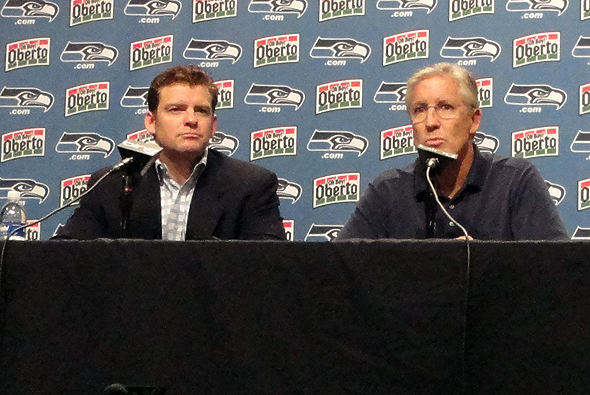
RENTON With the sixth pick in the 2010 draft, Seattle Seahawks general manager John Schneider said that his kids could have made the right selection; the obvious inference being that its a lot easier to get that future franchise left tackle as the Seahawks did with Russell Okung than it is to find the proverbial needle in a haystack later in the process.
Of course, if getting the early picks right was so easy, we wouldnt still be laughing about Ryan Leaf and JaMarcus Russell.
The key to the process is to have a front office working in concert, and thats something that Schneider and head coach Pete Carroll also in his second year with the team seem to have developed.
Though both decision-makers may come with different player and positional preferences, Carroll and Schneider seem to have found a system that beats the potential dysfunction polluting the worst NFL front offices. As both men explained in the teams pre-draft press conference Tuesday, its like anything else on personnel evaluation it starts with the same idea of competition that fires everything else in the current organization.
We spend a lot of time talking through it, Schneider said. We have a lot of philosophical discussions that arent finished in two minutes. This is a process that started 11 months ago. Pete and his staff have been drawn into it, and, as soon as the season ended, they became more involved. Pete and I will talk though some things, and well work it out.
We operate with the thought that we want to bring out the best of what we have, Carroll said. So, we put them together, and we work it out, and we keep pounding away at stuff until we get to what we feel we agree upon, and we have never even had an issue with that.
“Sometimes, youve got to battle back and forth, and you dig and scratch and claw until you find the answers, and were more than willing to compete to do that. We pool our ideas and our thoughts, and we use our coaches, too. We use our scouts everybody. Well take in all the information we can get and we feel comfortable that we can come to a good conclusion.
To me, its a competition. Youre battling to figure it out, so how many different ways can you look at it? How much information can you draw? How many phone calls how many ways can you go about looking at the information?
For Schneider, another key to success is letting his scouts know that the evaluation process is an ongoing one sticking to a grade you gave three months ago just to appear right, when circumstances change as quickly as they can among college players, is a fools errand.
I would say that everyone feels very comfortable with their role in our football operations department in terms of their opinions, he said. As long as theyve done the work, theyre free to express their opinions and philosophies and what they think about a player. There are a lot of talented people in this building, and at the end of it, Pete and I figure it out. And Petes not the kind of head coach thats going to slam his fist on the table and say, This is the way it is.
Part of the beauty of our system is that we dont hold our scouts true to their grades throughout the fall. They have the freedom to go back into the school and not have the pressure of saying, Hey, Ive got to have this guy right, right away, or Im gonna get scrutinized because I didnt have them. They have all the way until the middle of January to put a grade on a guy. Theres a certain freedom there we all put pressure on ourselves to do a great job, and this just allows people to be able to constantly go back and review. Once we bring the coaches into the process, we do the same thing.
Two common denominators among the best front offices are the ability to hit on small-school prospects, and the intuitive sense of how to balance the risk/reward aspect of the talented player with serious character issues. Schneider and Carroll are heading a personnel department on the way up because they have a system in place for both of these aspects.
You definitely have to weigh the level of competition, and we do that by conference with the big-school guys [as well], Schneider said of the challenge in isolating the small-school player with NFL attributes who is destroying the under-talented people around him. We weigh each guy, depending on their competitiveness and athleticism, their character, and obviously their physical characteristics. If you have a Division III player whos kicking butt and looks like me, were not going to pay attention to him.
That caused Carroll to chime in once again. We use the experience of our staff as well. Theyve seen guys over the years, and theyve been able to measure the level of play, and how that translates. Thats what the [scouting] combine offers you an opportunity to get different guys on a level playing field when you can. Its not always possible, so youve got to go with the experience of understanding that level of play.
Carroll created an environment in 2010 that caused some fringe-character players to buy in as much as they had to if they wanted a roster spot, but having that methodology in place doesnt mean that theyd automatically be predisposed to taking a risk on a player who popped off the tape and goofed up off the field. Its a finer balance than it seems.
Were very careful about evaluating our players from all aspects, Carroll said. What they offer in the locker room, and what they offer character-wise thats really important to us. I feel like Ive coached a lot of different kids over the years, and Ive reinforced [personnel decisions made with] John several times I think I understand this guy; lets see what he brings and what he offers. I think I can really help him. And then, there are other cases where youll say, Ah, this guy is a hard guy to reach, and he might not be a guy who fits with us. So, its a very important issue for us, because we want to make this a really rock-solid football team.
The Seattle sports scene is full of first-year wonders; supposed team saviors who found it easier to correct the mistakes of others than their own. If Carroll and Schneider are able to transcend that trend, it will be because they understand their own processes, and respect the value of the people around them. It may sound hippy-dippy, but the holistic approach seems to be working for this new version of the Seahawks.
Soon, it will be time once again to test those highfalutin theories in the relative real world of the NFL draft.
9 Comments
Great read and interesting stuff. I’m sure Locker would love to come back this season and play behind this line and with these receivers, plus, and a huge plus, a real tight end. I don’t know whether his numbers would be this over the moon but it is a great subject to discuss over a few brewskis.
Thanks for a great article.
Interesting…it will be fun to see if he can sustain those numbers playing USC, OR and Stanford instead of EWU and HI.
“12.5 percent of Prices 122 throws have resulted in touchdowns (3 vs.
Eastern Washington, 4 vs. Hawaii, 3 vs. Nebraska, 3 vs. California).”
3+4+3+3 != 14
He threw for 4 TDs vs. Nebraska as well as vs. Hawaii.
Montana may want to transfer. These numbers are remarkable!
As much as I like the way Locker finished last year, I always had problems with his lack of touch and accuracy passing the ball. We kept waiting for him to “finally get it”, but he never really did. He became a better quarterback last year, but his passing was still average at best. They always said he had “a canon for an arm”, but canons are not the most accurate of weapons.
How many times did we see receivers as open as Polk was on his touchdown reception Saturday, only to see Jake sail the ball 4 or 5 yards over their heads? But he made up for this with his athleticism and his leadership. The Denver Broncos have a similar athlete on their roster who’s currently their 3rd string quarterback.The Huskies finally have a quarterback who’s throwing ability is not a liability. In fact, his only liability seems to his physical size — compared to most quarterbacks, he is on the short side — around 6′ tall. But when he is on the field the Husky offense seems to move almost effortlessly down the field. Like Locker, he appears to possess those intangible qualities such as leadership. He also smiles a lot too, which gives the play by play guys something to comment on when the camera pans the sidelines. This might be the beginning of something special.
The “Price” is right!! Go Keith! I love you cousin! Also, how come we can’t find his jersey anywhere? What’s up with that?
I have always stated that Jake Locker was a great athete at UW, but not that great of QB in the sense of what that position is suppose to be. And certainly he wouldn’t be Coach Sark’s first choice, if both showed up on the same day, as Jake came from a high school that ran a form of the Veer offense. He was not a passing QB in high school. Price, to my surprise, seems to be a more typical QB type and a much better passer, considering Nick Montana can’t pass him in the depth charts. At 6’1″ I don’t feel Price is that short if you compare him to Drew Breeze and such QB’s in the NFL. He could stand to put a few more pounds on the body though.
I just read the interview with Don James and they asked him about Keith Price vs. Jake Locker.
The Dawgfather said both were excellent, but Price has far more targets that Jake ever had – primarily the 2 freshman All Americans, and a 6’6″ tight end. Locker never had a TE and there were no plays to that position, which made things a lot tougher for Jake.
He also said Price is getting much better protection and time to throw the ball.
Considering everything, they are both great QBs, but Price needs to hit the weight room. He seems fragile. Locker took far more punishment and kept going.