

Since 1901, more than 14,000 men and women have struck an oar in the water on behalf of the University of Washington, whose rowing program is the most successful athletic enterprise in the state’s history.
UW men and women have combined to win 21 national championships and 172 conference championships (all categories of races). Eighty UW rowers have participated in 13 Olympic Games, and three Washington shells (1936, 1948 and 1952) have won Olympic medals.
Husky men and women have won races and regattas on such far flung waters as the Thames in London, the Nile in Egypt and on reservoirs in Russia and Germany. The UW men won the Grand Challenge Cup at the Henley Royals Regatta (1977) and the Husky women won the Henley Prize at the same competition (2000).
The National Rowing Foundation Hall of Fame includes 27 individuals who coached or rowed for Washington, and a dozen others who entered the Hall of Fame for the work they did after leaving Washington. What follows are highlights of the greatest men, women and moments in the school’s storied rowing history.
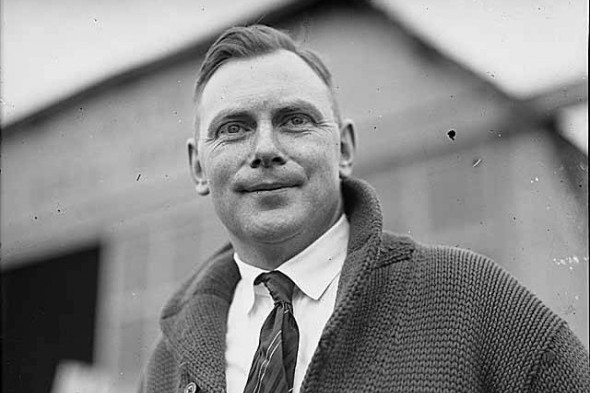
Hiram Conibear meets Bill Speidel, 1906
A Chicago native, Conibear held two jobs in 1906. He served as athletic trainer at the University of Chicago and performed similar duties for the Chicago White Sox. While working at the university, Conibear met Speidel, a second-year medical student who had captained and quarterbacked the 1903 UW football team. Speidel became so impressed with Conibear that he contacted UW athletic manager Lorin Grinstead and talked him into offering Conibear the job of UW athletic trainer, then talked Conibear into moving to Seattle. Shortly after Conibear arrived at UW, Grinstead talked Conibear, who admitted he didnt know one end of a boat from the other, into becoming Washingtons crew coach. Conibear read up on physics and decided that the traditional Oxford style of rowing, in which oarsmen put their maximum power at the end of a long layback stroke, was unsound and uncomfortable. Experimenting with a broom instead of an oar and using a skeleton (borrowed from the UW biology department), Conibear came up with a shorter stroke that provided more power and eliminated drag. By the time Conibears career ended in 1917, Washington had become a national rowing power, and his Washington stroke was used throughout the world.
- Conibear purchased Washington’s first racing shell, from Cornell University, in 1907.
- Conibear served as an athletic trainer the University of Montana and University of Chicago prior to joining the UW.
- Washington received its first invitation to the Intercollegiate Rowing Assn. Regatta in 1913, when Conibear headed the rowing program. UW was the first western school invited to the prestigious event.
- Conibear died on Sept. 9, 1917, after breaking his neck in a fall from a plum tree in his yard on Brooklyn Ave.
Hiram Conibear Meets George Pocock, 1912
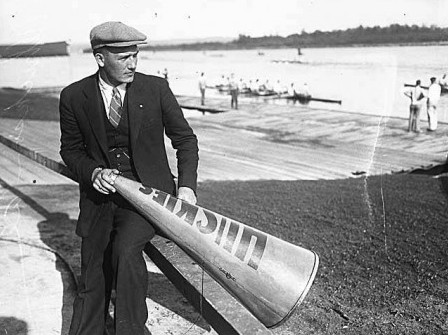
Five years after Conibear arrived at Washington (1912), he persuaded England-born George Pocock to abandon his boat-building business in Vancouver, BC., and set up shop on the Washington campus. Using shells designed by Pocock, Washington rose to rowing prominence, winning the first of many national championships in 1923 at the IRA Regatta in Poughkeepsie, NY. By the early 1920s, Pocock began receiving orders for his unique shells from all over the world. Pocock ultimately supplied nearly every college and university in the country with his shells, many of which were used by gold-medal crews in the Olympics. Pocock remained at the UW for many years, frequently acting as an unofficial assistant and advisor to the UW coaching staff.
- One year after Pocock hooked up with Conibear, the UW received its first invitation to the IRA Regatta in Poughkeepsie, NY. Washington’s third-place finish shocked the rowing world and established the West Coast as an emerging power in the sport.
- In 1999, the Seattle Times prepared a list of the top 100 figures in Seattle sports during the Twentieth Century. George Pocock ranked No. 13.
- In 2010, the Rowing Almanac listed George Pocock as the most important person in the history of American rowing.
- Pocock’s son, Stan, rowed for the UW, coached at Washington from 1947 to 1955, coached gold-medal crews in the 1956 and 1960 Olympic games, and became the first coach of the Lake Washington Rowing Club upon its formation in 1958.
- During World War I, the Pococks (brothers George and Dick) earned their livings by building floats for seaplanes for Bill Boeing, the businessman who started Boeing Aircraft Company.
The Varsity Boat, 1916
The 1916 crew produced an undefeated season, highlighted by a lop-sided seven-length rout of Stanford and a nearly one-minute victory over California, 16:56 to 17:41. Most interesting about the crew is that two future coaching legends occupied the shell. Ed Leader had a long career as head coach at Washington and Yale. Carroll “Ky” Ebright coached at California from 1924 to 1959. In the five Olympic eight-oared events between 1924 and 1948, Yale and Cal crews led by Leader and Ebright,won gold medals in four of them. The only year they didn’t, 1936, Washington struck gold.
First IRA title, 1923
When Washington, coached by Rusty Callow, upset Navy at the Intercollegiate Rowing Association Regatta (IRA) in Poughkeepsie, NY, it became the first crew from the West Coast to capture the Varsity eight race in 18 years. The victory not only put UW rowing on the national athletic map, it became the first in a long line of championship squads (UW went on to win nine IRA titles by 1950). Callow’s rowers, inducted en masse into the Husky Hall of Fame in 1990, consisted of Max Luft, Charles Dunn, Fred Spuhn, captain Sam Shaw, Pat Tidmarsh, Rowland France, Harry John Dutton, Dow Walling and Don Grant. The Huskies raced for three miles against shells from five other schools, winning by a length in a heavy rainstorm. Official times: 1. Washington, 14:03.15; 2. Navy, 14:07.25; 3. Columbia, 14:15.45; 4. Cornell, 14:19.45; 5. Penn, 14:21.35.
- Callow rowed for Washington in 1914-15 (No. 7 seat) and also played football and ran track. On 1916, he served as president of the Associated Students at the University of Washington.
- Callow coached the Huskies to IRA championships in 1924 and 1926, and to runner-up finishes in 1925 and 1927.
- Asked by Sports Illustrated in 1955 why he left Washington for Pennsylvania, Callow said, “It was the difference between $10,000 and $3,000”.
- Callow’s Navy crew won the gold medal in eight at the 1952 Helsinki Olympic Games.
- The “Russell S. Callow Award” is presented annually by the Eastern Association of Rowing Coaches to the collegiate crew that, in the previous racing season, best personified the virtues of “spirit”, “courage” and “unity.” The award has been presented annually since 1963.
- Callow coached at Washington from 1922-27, at Pennsylvania from 1928-49, and at Navy from 1950-59.
- Callow entered the National Rowing Hall of Fame in 1956, as did Donald Grant, one of three individual UW rowers enshrined (1972), along with Stork Sanford (1956) and Ted Garhart (1972).
- Don Grant directed the Huskies to their first IRA victories in 1923 and 1924, captaining the crew as a senior.
Spreading The Wealth, 1922-58
Some of Washington’s best rowers became greater coaches. Ed Leader (UW, 1916), who succeeded Hiram Conibear in 1917, became the head coach at Yale in 1922. Callow (UW, 1915), who succeeded Leader in 1922, became head coach at Pennsylvania and concluded a 37-year coaching career at Navy. Caroll “Ky” Eright (UW, 1917), coached for 35 years (1924-59) at Cal, winning five national championships and three Olympic gold medals. Rollin Sanford (UW, 1926) coached Cornell for 33 seasons, winning four straight national titles in the 1950s. Tom Bolles (UW, 1926) coached at Harvard for 15 years (1936-51). Norm Sonju (UW, 1927) coached at Wisconsin for 22 years.
Olympic Gold Medal, 1936
Washington’s varsity eight won gold at the Berlin Games, rowing in the “Husky Clipper”, a shell designed by George Pocock. In the preliminaries, UW established a world record for 2,000 meters, clocking 6:00.8. In the medal race, the UW got off to a poor (last-place) start and trailed Germany and Italy by a substantial margin. But the Husky crew closed to within a length with 600 meters remaining and then picked up the pace. The Huskies passed Britain, Switzerland, Hungary and Germany. Then, with about five strokes left, the Al Ulbrickson-coached Huskies whizzed past the Italians and Germans for the gold (margin of victory was a length and a quarter in a time of 6:24.4), infuriating race observer Adolph Hitler. The gold-medal crew included consisted of Roger Morris (bow), Charles Day (2), Gordon B. Adam (3), John G. White (4), James B. McMillen (5), George E. Hunt (6), Joseph Rantz (7), Don B. Hume (8) and Robert G. Moch (cox). In 1979, the 1936 crew became the first “team” inducted into the Husky Hall of Fame. All the oarsmen were charter members, along with their coach, Al Ulbrickson.
- Said Ulbrickson after the race: “The boys won that race on courage. I thought (Don) Hume was going to collapse in the last 100 meters when they lifted the beat to 40. Where he got the stuff to finish the way he did I’ll never know. It was a magnificent performance.”
- Washington earned the right to represent the United States in Berlin by scoring a 1 1/4-length victory over Pennsylvania at the Olympic Trials.
- Seventeen crews made up the 1936 Olympic rowing field.
- The 1936 Huskies won every race they entered, including the Pacific Coast Championships, IRA Regatta, the National Sprint at Princeton and the Olympic Games.
- Members of the 1936 gold-medal crew entered the National Rowing Foundation Hall of Fame in 1971.
- Four members of the 1936 crew lived into their 90s.
IRA Sweeps, 1936, 1937, 1948, 1950
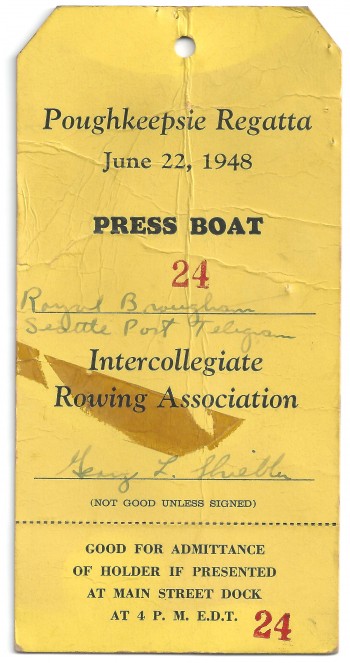
Al Ulbrickson, UW rowing coach from 1927-58, took numerous crews to the IRA Regatta. He won the varsity eight race six times, and on four occasions — 1936, 1937, 1948 and 1950 — Ulbrickson’s Huskies “swept the river”, winning varsity eight, junior varsity and freshman gold medals.
Men’s Eight, 1940
Due to World War II, one of the most dominant crews in Washington history never had an opportunity to take part in the Olympic Games (Olympics cancelled in both 1940 and 1944). The 1940 varsity eight completed an undefeated season by capturing the IRA title in Poughkeepsie, NY., with rowers Ted Garhart, Dallas Duppenthaler, Dick Yantis, Chuck Jackson, Gerald Keely, Sr., Al Erickson, Paul Soules, John Bracken and Frederick P. Colbert. In that competition, the Huskies contested Cornell, Syracuse, Navy, California, Columbia, Wisconsin and Princeton on the Hudson River. Cornell challenged Washington at the finish of the four-mile event, but UW won its sixth national title. The group of four sophomores, three juniors and one senior became the youngest crew ever to row under Washington’s colors at the IRA championships.
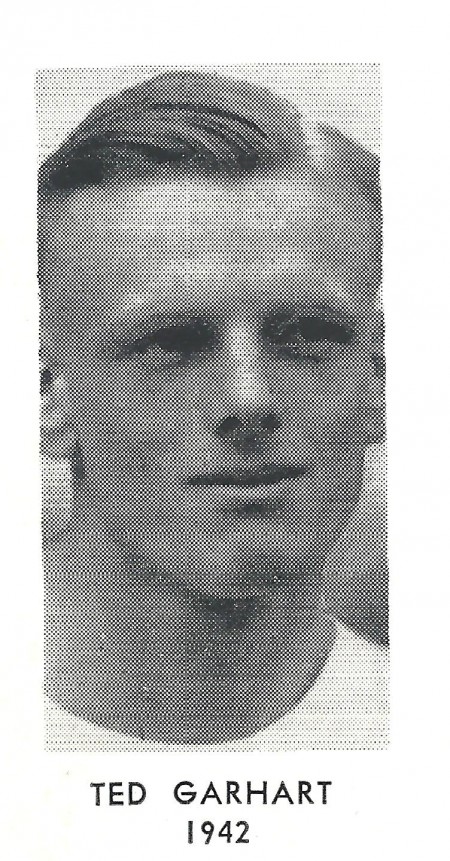
- Garhart, a member of the National Rowing Foundation Hall of Fame, never lost a varsity eight race in his three years at Washington and stroked the Huskies to IRA national titles in 1941 and ’42.
- “He never lost a race in the stroke seat at Washington,” Dick Erickson, the Husky crew coach from 1967-88 once said. “That has not happened before or since. Afterward, he was a very loyal Husky fan.”
- Garhart (1942) is the only Washington rower named Seattle Post-Intelligencer Sports Star of the Year (award called “Man of the Year” when Garhart won it), and one of three individual UW rowers enshrined in the National Rowing Hall of Fame (also Donald Grant and Stork Sanford).
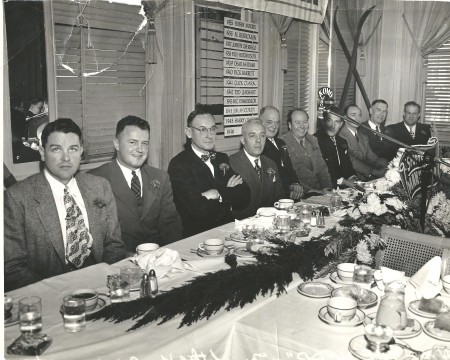
Based solely on record, this might have been the greatest crew in UW history. Ted Garhart (stroke), Walt Wallace, Bill Neill, Paul Simdars, Tom Taylor, Chuck Jackson, Doyle Fowler, John Bracken and Vic Fomo (coxwain) not only won the IRA Regatta in Poughkeepsie, NY., but Garhart, Bracken and Fomo ended their four-year careers having never lost a race. The entire crew entered the Husky Hall of Fame in 1991.
Olympic Gold Medal, 1948
The UW “Clipper Too”, consisting of Gordon Giovanelli (bow), Bob Will (2), Bob Martin (3), Warren Westlund (4) and Allen Morgan (c), won the gold medal in men’s coxed fours on the Thames River in London on Aug. 9, 1948, defeating Switzerland by two lengths in a time of 6:50.3, and Denmark by eight seconds. The crew entered the National Rowing Hall of Fame in 1975, Citizens Savings Foundation Hall of Fame (formerly Helms Foundation) in 1976, and the Husky Hall of Fame in 1981.
- The Seattle Post-Intelligencer named George Pocock, master boat builder and mentor to nine generations of Husky oarsmen, its “Man of the Year” in 1948 (Pocock designed the gold-medal shell used by UW in the Olympic Games).
- The UW qualified to race at the London Olympics by winning the U.S. Olympic Trials in Princeton, NJ.
- Pocock served as coach of the Husky four, at the request of head coach Al Ulbrickson.
- In the eight-oared race at the 1948 Olympics, the University of California won the gold medal using a Pocock-built shell. The Bears defeated England, the odds-on favorite.
- Immediately following Washington’s successful performance at the Olympics, UW Alumni Director Richard Curly Harris, captain of the 1931 varsity rowing team, lobbied the Washington State Legislature for $365,000 to build the Huskies a shellhouse. The new facility, built on the site of an old refuse dump north of the Husky Stadium, officially opened in the fall of 1949. It was named the Conibear Shellhouse, in honor of Coach Hiram B. Conibear, the father of the rowing program at the UW.
Olympic Bronze Medal, 1952
One of three University of Washington crews to earn an Olympic medal, this coxed four hit the finish line at Meilahti Gulf, near Helsinki, Finland, in 7:37.0, just 0.5 seconds behind the silver-medal Switzerland team and four seconds in arrears of gold medalist Czechoslovakia. The crew UW consisted of forward stroke Fil Leanderson (2), Dick Wahlstrom (3), Al Ulbrickson Jr., Carl Lovsted (4) and cox Al Rossi. The UW raced in a George Pocock-designed shell.
- Three Pocock shells won medals in Helsinki. In addition to the bronze won by the UW, a pair of Rutgers rowers won the two-oared coxless shell, beating Belgium and Switzerland. Coach Rusty Callows Naval Academy crew, polishing off an unbeaten season, won a gold medal in the eight-oared competition, easily beating the Soviet Union by one-and-a-half lengths and Australia by two lengths. Callow served as the UW head coach from 1922-27.
- Forward stroke Fil Leanderson, who grew up in Alderwood Manor, served as Washington’s head rowing coach from 1959 to 1967, and led the Western Washington program from 1977 to 1993. In all, he coached for 31 years.
UW Beats the Russians, 1958
A scandal in the UW football program — boosters paid players, resulting in sanctions against all of the school’s athletic teams — prevented coach Al Ulbrickson’s rowers from taking part in the 1958 national collegiate championships. In lieu of that competition, the Huskies accepted an invitation to compete in the Henley Royal Regatta on the Thames River in London, and in an international meet on the Khiminskoe Reservoir outside of Moscow, Russia, that had been arranged by the State Department as part of a cultural exchange. At Henley, the UW eight drew defending world champion Trud Club of Leningrad, and lost by a length and a quarter. Trud went on to win Henley’s Grand Challenge Cup. Fifteen days later, on July 19, the Huskies lined up against four Russian crews — Trud Club, Soviet Army, Moscow Spartak and Kiev Dynamos. With KOMO sports director Keith Jackson broadcasting the race live — the first airing of a sports event from behind the Iron Curtain — the UW caught and passed the Soviet Army shell at the 500-meter mark. At 1,000 meters, Washington opened up a one-length lead over Trud and went on to win by one and three-quarters lengths in 6:18.06, one of the greatest upsets in rowing history.
- The UW crew of John Bisset, John Sayre, Andy Hovland, Louis Gellermann, Chuck Alm, Phil Kieburtz, Roger MacDonald, Dick Erickson (future UW head coach) and Bob Svendsen rowed to an outstanding intercollegiate season before traveling to Moscow. Washington defeated Cal, Stanford and the University of British Columbia as a prelude to racing at Henley.
- Warren Westlund became a prominent Seattle auto dealer and life-long sports fan. He died on Feb. 13, 1992.
- In 1988, several crew members, including Westlund, celebrated the 40th anniversary of their Olympic victory by returning to London for the Royal Henley Regatta.
- Westlund served on the university’s Board of Rowing Stewards for 32 years. He was elected to the UW Athletic Hall of Fame in 1981. Later, he was elected to the National Rowing Hall of Fame. He also served as president of the Alumni Big “W” Club and as a member of the Tyee Board of Husky football boosters.
- Erickson, who coached at UW from 1968-87, entered the National Rowing Hall of Fame in 1991 and the Husky Hall of Fame in 1994.
- In 2010, Washington’s victory over the Russians was named the top local sports story of the past 75 years — ahead of the Sonics’ 1979 NBA title victory and Washington’s co-1991 national football championship.
Al Ulbrickson, Dick Erickson, Bob Ernst, 1927-11
The areas most enduring tradition of athletic success is UW rowing, which had three major figures after the death of Hiram Conibear (1917). Ulbricksons crews won six Intercollegiate Rowing Association regattas in the 1930s and 1940s, coached crews that won Olympic gold in 1936 and 1948, and stunned the Russians in Moscow in 1958. Erickson (1968-87) won at Henley and a U.S. national title, and helped found the womens program. Ernst is the only coach to win national titles with mens and womens eights, coached the U.S. women to Olympic gold in 1984, and at the 2007 IRA regatta became the first coach since 1950 to have a mens varsity, junior varsity and frosh crews win gold.
John Sayre, 1958, ’60, ’65
Sayre helped Washington knock off Trud Club of Leningrad in the Huskies’ memorable upset victory in 1958. Two years later, at the 1960 Rome Olympics, he won a gold medal as part of the USA’s coxless fours. In 1965, he teamed with Rusty Wailes, a Seattle native, two-time Olympic gold medalist, and Yale graduate, to form a musical group called “Sing-Out 65”, which became “Up With People.”
Jan Harville, 1970-73
With the possible exception of Bob Ernst, no individual has a greater track record with the University of Washington’s women’s rowing program than Harville. Between 1970-73, she became the school’s first national-caliber female rower, later made two Olympic teams (1980, ’84) and earned three World Championship medals. Harville gained even greater fame as a coach, leading Washington to seven national championships. She entered the Rowing Hall of Fame in 1991.
Grand Challenge at Henley, 1977
With a one-length triumph over the British national crew, Washington became the first United States entrant in 18 years to win the prestigious Grand Challenge Cup at the Henley Royal Regatta. The Huskies hadn’t been given much of a chance, especially by local media. But in a tune-up race at Nottingham, the varsity served notice that it was ready, finishing second to the British National Team by a half-length, but ahead of Harvard, the Eastern Sprint champion. An excited UW coach Dick Erickson said We just flat-out out-rowed Harvard. It was a big day for Washington over here. What happened here will really help our confidence as we train for the Henley Regatta. In the Grand Challenge semifinals, the Washington varsity, which had drawn a bye in the first round, faced Garda Siochana (Irish National Team), which had dispatched California in the first round. The Huskies had a start that put the fear of God in them according to Erickson, and veered off course toward the log boom, but settled down and began to row consistently. Once back in the race, the crews were never separated by more than a few seats, Washington sprinting to win by a half-length. They rowed for their life today said Erickson, whose Huskies cruised home in 6:27.
- “They responded tactically along the course just perfectly,” said UW coach Dick Erickson. “I didn’t realize how much this meant to them until this day.”
- The winning UW boat featured John Stillings (coxwain), Mike Hess, Jesse Franklin, Terry Fist, Mark Miller, Mark Umlauf, Ross Parker, Mark Sawyer and Ron Jackman.
- Prior to their win at Henley, the Huskies won the Pac-8 title and finished second behind Pennsylvania in the San Diego Crew Classic.
- Washington also won the uncoxed four — the Visitors’ Cup — at the 1977 Henley Regatta.
- Before Washington won the race, the previous U.S. winner had been Harvard in 1959.
- The 1977 crew entered the Husky Hall of Fame in 1999.
- In 1973, UW lost the Grand Challenge at Henley to the Soviet Union.
- No. 6 Mike Hess, one of the best modern-era UW rowers, stroked the Huskies to victory in the Grand Challenge Cup. A year earlier, he rowed in the 1976 Olympic Games in Montreal in the American eight.
Women’s Eight / 1981
Competing in their first Women’s Collegiate National Championship on May 23, the UW women captured the 1,000-meter title — and the program first’s crown — by defeating Yale by two seconds on Oakland’s Lake Merritt. The Huskies, who did not compete in the 1980 national championships after being dominated by California in the regular season, took charge in the early strokes and won by two-thirds of a length. “The kids won it in the very first strokes,” said coach Bob Ernst. They just opened and opened until 750 meters. They just rowed away from everyone.” Washington stopped the clock in 3:20.8, ahead of Yale at 3:22.9, Boston University, 3:24.8, Stanford, 3:27.8, Wisconsin, 3:28.7 and California, 3:29.7. The crew consisted Lisa Horn (coxwain), Jane McDougall (stroke), Madeline Hansen (2), Sue Broom (3), Karen Mohling (4), Peg Achterman (5), Kristine Norelius (6), Shyril O’Steen (7), Debbie Moore (bow).
- Three years after helping the Huskies win their first national title, Kristine Norelius and Shyril O’Steen became part of the USA’s eight-oared shell that won an Olympic gold medal in Los Angeles.
- Coxwain Lisa Horn did not get dunked in the lake following Washington’s victory (the normal celebration) because the water was deemed too polluted.
- This would be the first of five consecutive national championships for the UW women. They won also won in 1982 at Lake Waramug, CT., in 1983 at Lake Wingra, Madison, WI., in 1984 at Green Lake, Seattle, WA., and in 1985 at Occoquan Reservoir in Arlington, VA.
- The 1981 8-oared crew entered the Husky Hall of Fame in 1989. The 1982 and 1983 8-oared crews entered in 2001.
National Championship Sweeps, 1984, 1997
In 1984, the UW men won the national championship on Lake Harsha in Cincinnati, defeating Yale 5:51.1 to 5:55.6. The UW women captured the fourth of five consecutive NCAA titles by clocking 3:29.5 to Radcliffe’s 3:31.2 on Green Lake in Seattle. That marked the first time the men’s and women’s programs won national titles in the same year. But the Huskies never had it better than in 1997, when Bob Ernst’s men swept all three eight-oared races (varsity, second varsity, freshman) at the IRA Regatta in Camden, NJ., and Jan Harville’s women made history as her crews won the first NCAA-sanctioned national championship at Lake Natoma, near Sacramento, CA.
- The 1997 men’s 8-oared crew — Bob Cummins, Brett Reisinger, Silas Harrington, Andy Tyler, Matt Anderson, Matt Schostak, Aaron Beck, Carl Bolstad and coxwain Sean Mulligan — entered the Husky Hall of Fame in 2008.
- The 1997 women’s 8-oared crew — Alida Purves, Kelly Horton, Tristine Glick, Katie Dunnet, Jan Williamson, Denni Nessler, Annie Christie, Sabrina Teleska and Kari Green — entered the Husky Hall of Fame in 2008.
Olympic Gold Medal, 1984
Washington had three women in the U.S. eight-oared shell, coxwain Betsy Beard, Shyril O’Steen (1) and Kristine Norelius (6), which was coached by Bob Ernst, women’s rowing coach at the UW. The USA, clocking 2:59.80 at Lake Casitas, near Ohai, CA., defeated Romania (3:00.87) and the Netherlands (3:02.92) for the gold medal. It marked the first time that American women had captured the top prize in the Olympics.
- Betsy Beard served as the coxwain on the UW’s 1983 national championship Varsity Eight.
- Beard also served as coxwain for the USA eight-oared shell in 1988 that finished sixth in the Olympic Games in Seoul, South Korea.
- Beard, who became a pharmacist, married John Stillings, who won a silver medal in the 1984 Olympics in men’s coxed fours.
- Prior to earning an Olympic gold medal in 1984, Kristine Norelius helped the UW women collect their first two national championships, in 1981 and ’82. Before that, she earned a spot in the U.S. shell that boycotted the 1980 Moscow Games.
Olympic Games Medals, 1984
Washington athletes came away from the 1984 Olympics in Los Angeles with nine medals, including five gold and four silver. Gold medalists: Betsy Beard (women’s eight), Paul Enquist (double sculls), Blair Horn (men’s eight), Kristine Norelius (women’s eight), Shyril O’Steen (women’s eight); silver medalists: Charles Clapp (men’s eight), Al Forney (fours with coxwain), John Stillings (fours with coxwain), Ed Ives (coxless pairs).
- Ives, the cox at UW from 1979-83, twice appeared in the Olympics. In addition to winning a silver, in 1984, he competed at Seoul in ’88. Ives rowed in two Pac-10 championship eights for the Huskies, and was a winner at Henley in ’81 in the junior varsity eight. He also earned gold medals in the Goodwill Games and Pan American Games and a bronze medal in the World Championships.
Women’s Sweep, 1987
In Bob Ernst’s last season as women’s head women’s coach (before he took over the men’s program), his varsity, junior varsity and varsity four swept the nationals at Lake Natoma, near Sacramento, CA., capturing all three titles for the first time in school history. The varsity eight boat included Trish Lyndon (cox), Kris Stanford (stroke), Alice Henderson (7), Lisa Beluche (6), Heidi Hook (5), Sara Watson (4), Fritzi Grevstad (3), Katarina Wikstrom (2) and Linda Lusk (bow).
Women’s NCAA Team Champions, 1997, 1998, 2001, 2002
In 1997, UW women’s coach Jan Harville made history as her crews won the first NCAA-sanctioned team title at Lake Natoma in Sacramento — also the first NCAA team title for Washington in any sport. The UW also won national titles in 1998, 2001 and 2002.
Men’s IRA Sweeps, 1997, 2009
Between 1927-50, coinciding with the coaching tenure of Al Ulbrickson, Washington rowers “swept the river” (varsity eight, junior varsity eight, freshman eight) at the Intercollegiate Rowing Association Regatta four times — 1936, 1937, 1948 and 1950. Washington did not achieve the trifecta again until 1997, and collected its sixth eight-oared sweep in 2009 on Lake Natoma (Sacramento) when the varsity eight defeated California and Stanford, the second varsity eight whipped Brown and California, and the freshman eight scored a seven-second win over Harvard.
Henley-on-Thames, England / July 2, 2000
The Henley Royal Regatta introduced an open women’s race in 200o, consisting of quarterfinals, semifinals and a grand finale for the “Henley Prize”. Washington sent a crew to participate and the Huskies defeated the Univeristy of Victoria (British Columbia) in the main race, receiving the first women’s trophy awarded since the historic men’s regatta began in 1839. Washington won by one-half length in a time of 7:29. “That was an awesome race,” said UW coach Jan Harville.
- The winning UW shell contained Mary Whipple (cox), stroke Sabina Telenska (stroke), Nicole Borges (7), Theresa Nygren Birkholz (6), Vanessa Tavalero (5), Anna Mickelson (4), Lindsey Horton (3), Rika Geyer (2) and Nicole Rogers (bow).
- The Huskies covered the 2,112-meter Thames River course in 7:29, crossing the finish line half a boat length ahead of Victoria. The crews traded the lead throughout the course and kept it only one foot apart over the last quarter of the race before UW gradually began to break away towards the finish.
- “It’s interesting how they keep splits here. At each marker on the course, signs go up saying who’s ahead. We were ahead at the first mark by a foot. Then at the second marker, Victoria was ahead by a foot and then we went up again. I told our crew that Victoria had a fast boat and we would have to take the race away from them. We did it in the last 500 meters of the race. I am so proud that our crew could end its season this way. It was a tremendous opportunity to be here and represent the University of Washington,” said coach Jan Harvill.
- The 2000 Huskies also claimed gold at the San Diego Crew Classic, Windermere Cup and the Pac-10 Championships. UW won a silver medal at the NCAA Championships.
- Anna Mickelson and Mary Whipple joined the U.S. National Team after the win at Henley. They won a silver medal in eight at the 2004 Olympic Games in Athens and a gold in eight at the 2008 Olympics in Beijing, China.
Anna Mickelson & Mary Whipple, 1999-08
After helping the UW women win NCAA team titles in 2001 and 2002, Mickelson (6) and Whipple (cox) joined the U.S. National Team, ultimately becoming the only women with connections to the UW to medal in back-to-back Olympics. The pair earned a silver medal in eight in Athens (after setting a world record during preliminaries) in 2004 and added a gold in eight at Beijing in 2008.
- Mickelson and Whipple made All-America teams in 2000, 2001 and 2002.
- Mickelson and Whipple both rowed for the U.S. National Team for eight years.
Championships (Men)
- Varsity Eight: 1923, 1924, 1926, 1936, 1937, 1940, 1941, 1948, 1950, 1970, 1997, 2007, 2009.
- Junior Varsity Eight: 1925, 1926, 1927, 1935, 1936, 1937, 1938, 1940, 1948, 1949, 1950, 1953, 1956, 1964, 1972, 1993, 1995, 1997, 2004, 2005, 2007, 2008, 2009.
- Freshman Eight: 1931, 1934, 1935, 1936, 1937, 1939, 1947, 1948, 1949, 1950, 1951, 1953, 1961, 1969, 1997, 2001, 2002, 2006, 2009.
- Open Four: 2002, 2005, 2006, 2007, 2008
- Varsity Four: 2003, 2004
- Pair: 2001
- Freshmen Four: 2008.
Championships (Women)
- Varsity Eight: 1981, 1982, 1983, 1984, 1985, 1987, 1988, 1997, 1998, 2001, 2002.
- Junior Varsity Eight: 1981, 1982, 1983, 1984, 1987, 1989, 1994, 2002.
- Lightweight Eight: 1971, 1972, 1973.
- Lightweight Four: 1970, 1971, 1973.
- Lightweight Quad: 1972
- Flyweight Four: 1979, 1980.