

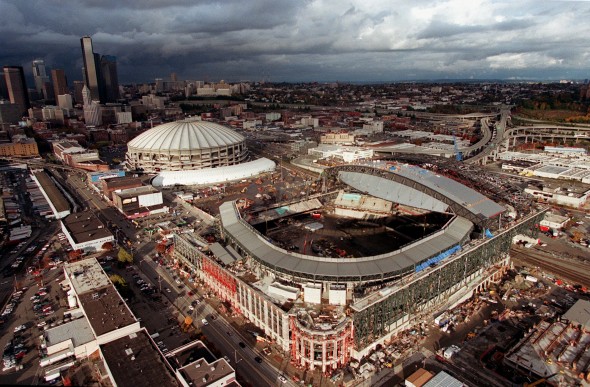
On a trip to Central Washington a few years ago, King County Council member Joe McDermott learned something about freight, the Port of Seattle and its busy SoDo neighborhood during a conversation with a hay grower.
The farmer told McDermott that when he makes plans to truck his loads of hay to the port, he first checks the Mariners home schedule.
“He also considers potential attendance when he times his deliveries,” McDermott said by phone Tuesday. “That told me all I needed to know.
“The potential arena is not bringing us anything we didn’t know. But it’s time for these concerns to be addressed.”
Imagine if the Mariners ever became good again: Grazing animals around the world could go hungry. Maybe there’s a reason to keep Chone Figgins on the roster, after all.
Regarding the congestion problems around the site of a $490 million basketball/hockey arena proposed by Chris Hansen, it’s hard to know who or what to believe among the competing studies and anecdotes. The release last week of a traffic analysis, a four-week quickie done by an outside firm hired by the city and paid for by Hansen, said the vast majority of arena events would have little impact on the district’s problems already afoot and, well, a-car.
Predictably, the report was met by a hardy-har-har by the numerous parties opposing the location.
The study “doesn’t pass the straight-faced test,” said Dave Gering, executive director of the Manufacturing Industrial Council. “I think this (arena proposal) was announced as a done deal by the mayor and the county executive. It would probably be way more surprising to see them come up with information now that casts doubt on their original conclusions.”
The question isn’t whether SoDo traffic isn’t often a mess. It’s how much worse it may become with an arena in use for 120-140 events a year. The answer isn’t as simple as saying that that the Port of Seattle closes most of its gates by 4:30 p.m., and most of the arena activity would be nights and weekends.
Ask the hay farmer. On 7 p.m. game nights, he probably wants his trucks in and out of Seattle by 2 p.m. That puts his trucks on Seattle streets earlier in the day, along with many other freight haulers packing a Mariners pocket schedule. The head-on conflicts aren’t the freighters’ problem; it’s the avoidance of head-on conflicts that gets them to town early and fills up streets, including the only quick east-west way to I-5 available to trucks: Atlantic Street/Edgar Martinez Way, Safeco Field’s southern boundary.
Here’s another little story about life in SoDo NoGo: Did you know that Metro buses no longer serve First Avenue South between Columbia and Lander streets, which is the front door of the stadiums?
Too congested.
Bus service was ended last fall because the preparations for the deep-bore tunnel dig that will replace the Alaskan Way Viaduct made traffic too difficult, according to Metro spokesperson Linda Thielke. The bus route was moved to Fourth Avenue, which isn’t terrible — unless you are walking in a downpour during autumn darkness.
Once the tunnel is operating in 2017 late 2015, the First Avenue route will return. In theory. The re-routing is called at the county “long-term temporary,” Thielke said. Isn’t that what is often said about increased health-care premiums?
These are the sorts of things that need to be handled with more than a cursory four-week study. Much as I want to see the return of the NBA, many of the arena advocates are presumptively dismissive of the potential headaches. I’m reminded of the TV commercials for beef jerky, “Messin’ With Sasquatch”: Mockery of some big fellas in this discussion can make them a tad obstinate.
Even Hansen told me in a recent interview that the traffic study he funded, on a scale of 1 to 10, with 10 being the mandatory full-blown environmental impact work, “is about a three.”
Which is, unfortunately, not nearly enough in the pursuit of facts that must come after the arena location was declared.
That’s why it was encouraging to see that McDermott, as chair of the county budget committee, appears to be serious in wanting more. McDermott announced Tuesday the names of what the county called “an independent panel of experts” who will take at least a couple of months to probably tell us a lot of what we know about SoDo, and maybe some things we have to know.
“These are professionals with a lot of experience in transportation, finance, real estate development and labor,” he said. “Everyone involved in this project is going to benefit from their review.”
The panelists were chosen from a field of people who were asked, among other things, if they might have a dog in the SoDo arena hunt.
“Some of those I approached said they or their firms might be involved, and could too easily be seen to have a conflict of interest,” McDermott said. “These people won’t have that problem. I’m very happy to have them.”
The seven panelists, all of whom are volunteering:
- Justin Marlowe, professor at the University of Washingtons Evans School who specializes in public financial management
- Steve Orser, urban developer
- Bill Beyers, UW geography professor
- Dick Conway, longtime local economist
- Tracey Thompson, secretary treasurer of Teamsters local 117
- Charlie Howard, transportation planning director for the Puget Sound Regional Council
- Doug MacDonald, former state secretary of transportation
Check out the links. Seems that the group has some comprehensive street cred when it comes to streets and all that is associated with them.
I know. Nobody wants to read more studies. Sorry. Can’t be helped. Hansen chose the site first, then asked permission. This is part of the deal, and he knows it.
To not give honest, objective consideration to all parties is to ram the project down throats, which just about guarantees the worst possible outcome — lawsuits.
Don’t want to see this project Sasquatched.
Editor’s note: A previous version of this column misstated the estimated date of the opening of the waterfront tunnel.
24 Comments
Excellent column.
Thanks, sdcall. Please tell your friends!
I agree with Sdcall, Art, and like him, I have no friends.
Go Sonics.
Excellent column.
Thanks, sdcall. Please tell your friends!
I agree with Sdcall, Art, and like him, I have no friends.
Go Sonics.
Very nice piece, Art, and it addresses something I’ve often noticed: The sense that this is going to happen regardless of whatever process is necessary to get it done. Hanson was on KJR yesterday talking with Dave Mahler (I wouldn’t even call it an “interview” because Softy was totally fatuous to the point of sounding like a groupie), and Hanson stated without hesitation that the NBA “will” be back in Seattle. On the basis of what knowledge? What has Stern told Hanson that he hasn’t told the taxpayers who’ll be on the hook for 40% of the cost of the new arena?
Hanson also said specifically there would be five (5) weekday afternoon events throughout the calendar year at the new arena, so there wouldn’t be the congestion in SoDo feared by many people. Has Hanson already been booking dates for an arena that isn’t even on the drawing board? Otherwise, how can he state without equivocation that there will be only five weekday afternoon dates in which the arena is being used?
I’m not opposed to a new arena in Seattle (I like the Key, but it’s location near Mercer Street isn’t exactly conducive to quick event turnarounds), but I do have a problem with this sort of “vote-for-it-now-and-we’ll-show-what’s-in-it-later” attitude being adopted in pushing it the same way Nancy Pelosi pushed Obamacare in the House. Much of the argument in favor of this arena has been veiled in vagaries and assurances with more basis in speculation than fact.
Since Hanson himself says it may be 2017 or so before an arena would open, what’s the hurry to get it approved this very instant? What window will otherwise close?
exactly. unless Hanson is desperate to land the Kings, Seattle is doing fine without NBA basketball so far, and hockey is looking like there’s yet another labor issue coming. Sounders are showing that waiting for a potential market to build isn’t necessarily a bad thing. and I think the NBA has to build up/gain back a little more goodwill in Seattle. call me bitter I guess. I wanted the Paul Allen reno of the Key. I’m still suspicious of this white knight galloping in to save the day. Alright, call me cynical, but I prefer the term “realist.”
Shut up loser Jim, you are going to be bowing to (and possibly blowing) this white knight in a few years when the Super Sonics are back kicking butt in a new gangster arena.
I think Hansen is sincere, and Seattle is doing fine — except for a little matter of feeling like downtown Kabul lately — with or without pro sports. And the Key renovation was Steve Ballmer’s idea, not Allen’s. The arena is a civic enhancement, not a need. No one has said otherwise.
Didn’t hear the interview, but I spent two hours with Hansen and I think his date conflicts figure is an estimate based on arena usage in other cities. And that isn’t really the point, as my column tried to point out.
But the creation of this independent panel is an indication that skeptics will get a fair hearing. The urgency is that there’s a slim chance the Kings could become available this summer, and Hansen wants to be ready to accept the relocation. He knows the new arena will be three years out, but there are tentative plans for a quickie upgrade of the Key. Otherwise, I’d be in favor of Vancouver B.C. as a temp home. Half-price tickets just like the Hornets had in OKC after Katrina.
Hansen does project sincerity, if not necessarily transparency. I’m thinking Wally Walker is a member of his group, which doesn’t really bother me (as long as he’s not GM or otherwise calling the shots), but Wally is a lightning rod locally and Hansen knows it. Otherwise, I’m not that suspicious of Hansen’s motives. Again, I’m not against this arena…I just want it done right. It’s not what SF is getting, but it’s as good as it’ll get in Seattle.
As for Vancouver, I’m dubious. The NBA left under a bit of a cloud there, too, and B.C. has never been that big on basketball (Steve Nash notwithstanding). I don’t see Vancouver being as receptive to the rent-a-team concept as OK City was because OKC was hoping to prove they could support an NBA team while Vancouver has been deserted by the NBA team they once had and will be less amenable to being a placeholder. The Key (and even the Tacoma Dome) may make more sense on a temp basis.
I guess the catch-all phrase I’ll use for the entire arena project is one Reagan used for Gorbachev and perestroika: “Trust, but verify.”
Very nice piece, Art, and it addresses something I’ve often noticed: The sense that this is going to happen regardless of whatever process is necessary to get it done. Chris Hansen was on KJR yesterday talking with Dave Mahler (I wouldn’t even call it an “interview” because Softy was totally fatuous to the point of sounding like a star-struck groupie at a Justin Bieber concert), and Hansen stated without hesitation that the NBA “will” be back in Seattle. On the basis of what knowledge? What has Stern told Hansen that he hasn’t told a public who’ll be on the hook for 40% of the cost of the new arena?
Hansen also said specifically there would be five (5) weekday afternoon events throughout the calendar year at the new arena, so there wouldn’t be the congestion in SoDo feared by many people. Has Hansen already been booking dates for an arena that isn’t even on the drawing board? Otherwise, how can he state without equivocation that there will be only five weekday afternoon dates in which the arena is being used?
I’m not opposed to a new arena in Seattle (I like the Key, but its location near Mercer Street isn’t exactly conducive to quick event turnarounds and it isn’t built to generate the kind of revenue a modern NBA arena has to), but I do have a problem with this sort of “vote-for-it-now-and-we’ll-show-what’s-in-it-later” attitude being adopted in pushing it the same way Nancy Pelosi pushed Obamacare in the House. Much of the argument in favor of this arena has been veiled in vagaries and assurances with more basis in speculation than fact.
Since Hansen himself says it may be 2017 or so before an arena would open, what’s the hurry to get it approved this very instant? What window will otherwise close?
exactly. unless Hanson is desperate to land the Kings, Seattle is doing fine without NBA basketball so far, and hockey is looking like there’s yet another labor issue coming. Sounders are showing that waiting for a potential market to build isn’t necessarily a bad thing. and I think the NBA has to build up/gain back a little more goodwill in Seattle. call me bitter I guess. I wanted the Paul Allen reno of the Key. I’m still suspicious of this white knight galloping in to save the day. Alright, call me cynical, but I prefer the term “realist.”
Shut up loser Jim, you are going to be bowing to (and possibly blowing) this white knight in a few years when the Super Sonics are back kicking butt in a new gangster arena.
I think Hansen is sincere, and Seattle is doing fine — except for a little matter of feeling like downtown Kabul lately — with or without pro sports. And the Key renovation was Steve Ballmer’s idea, not Allen’s. The arena is a civic enhancement, not a need. No one has said otherwise.
Didn’t hear the interview, but I spent two hours with Hansen and I think his date conflicts figure is an estimate based on arena usage in other cities. And that isn’t really the point, as my column tried to point out.
But the creation of this independent panel is an indication that skeptics will get a fair hearing. The urgency is that there’s a slim chance the Kings could become available this summer, and Hansen wants to be ready to accept the relocation. He knows the new arena will be three years out, but there are tentative plans for a quickie upgrade of the Key. Otherwise, I’d be in favor of Vancouver B.C. as a temp home. Half-price tickets just like the Hornets had in OKC after Katrina.
Hansen does project sincerity, if not necessarily transparency. I’m thinking Wally Walker is a member of his group, which doesn’t really bother me (as long as he’s not GM or otherwise calling the shots), but Wally is a lightning rod locally and Hansen knows it. Otherwise, I’m not that suspicious of Hansen’s motives. Again, I’m not against this arena…I just want it done right. It’s not what SF is getting, but it’s as good as it’ll get in Seattle.
As for Vancouver, I’m dubious. The NBA left under a bit of a cloud there, too, and B.C. has never been that big on basketball (Steve Nash notwithstanding). I don’t see Vancouver being as receptive to the rent-a-team concept as OK City was because OKC was hoping to prove they could support an NBA team while Vancouver has been deserted by the NBA team they once had and will be less amenable to being a placeholder. The Key (and even the Tacoma Dome) may make more sense on a temp basis.
I guess the catch-all phrase I’ll use for the entire arena project is one Reagan used for Gorbachev and perestroika: “Trust, but verify.”
Excellent column Art, as always!
My concerns on these studies isn’t so much how will traffic be impacted now but down the road. Do they fully take into consideration the anticipated construction for the area in regards to the taking down of the Viaduct and installation of the new tunnel? Did they anticpate later growth? What if the cruise ship terminal that was proposed for the waterfront happens? Look at the problems with I-5. It was built for the population of its time but didn’t anticipate later growth and now it’s too small for the current population. I don’t know if the studies paid for by Hansen and arranged by the city went that far but I suppose we can assume they did. However I hope they gave themselves a decent margin of error to avoid a repeat of the “problems” with Key Arena.
Seems to me if Key Arena isn’t an option and with SODO being somewhat controversial Hansen should keep an open mind on other venues. I’m sure the city of Belleuve would swing an excellent incentive package to lure an NBA team there and have even better traffic solutions. Same with Renton, Auburn and Kent. Just because a pro sport team isn’t in Seattle doesn’t mean it can’t still put Seattle on the jerseys. Sure, some fans wouldn’t go because those cities are too far away for them but by the same token you’d get new fans as well. And if you have a winning franchise people will come regardless of distance and eventually you get more sponsors and as a business you want that just as much as filling an 18,000 seat arena.
Thanks, J. This county panel knows its stuff, plus a lot more that you and I haven’t thought of. There’s no getting around one fact — Seattle’s weird hour-glass geography, just two north-south routes and one east-west road near the port, can’t be improved, except by adding an overpass at Lander, for $150M-plus. But Hansen can’t give up on it this early. County panel has to prove it’s a disaster and get five council votes to agree. Dow wants it bad. Not sure yet where it will go.
Excellent column Art, as always!
My concerns on these studies isn’t so much how will traffic be impacted now but down the road. Do they fully take into consideration the anticipated construction for the area in regards to the taking down of the Viaduct and installation of the new tunnel? Did they anticpate later growth? What if the cruise ship terminal that was proposed for the waterfront happens? Look at the problems with I-5. It was built for the population of its time but didn’t anticipate later growth and now it’s too small for the current population. I don’t know if the studies paid for by Hansen and arranged by the city went that far but I suppose we can assume they did. However I hope they gave themselves a decent margin of error to avoid a repeat of the “problems” with Key Arena.
Seems to me if Key Arena isn’t an option and with SODO being somewhat controversial Hansen should keep an open mind on other venues. I’m sure the city of Belleuve would swing an excellent incentive package to lure an NBA team there and have even better traffic solutions. Same with Renton, Auburn and Kent. Just because a pro sport team isn’t in Seattle doesn’t mean it can’t still put Seattle on the jerseys. Sure, some fans wouldn’t go because those cities are too far away for them but by the same token you’d get new fans as well. And if you have a winning franchise people will come regardless of distance and eventually you get more sponsors and as a business you want that just as much as filling an 18,000 seat arena.
Thanks, J. This county panel knows its stuff, plus a lot more that you and I haven’t thought of. There’s no getting around one fact — Seattle’s weird hour-glass geography, just two north-south routes and one east-west road near the port, can’t be improved, except by adding an overpass at Lander, for $150M-plus. But Hansen can’t give up on it this early. County panel has to prove it’s a disaster and get five council votes to agree. Dow wants it bad. Not sure yet where it will go.
Hopefully the debate won’t fall into (or perhaps remain I fear) as a false dichotomy of ‘the arena vs. the port’. It doesn’t have to be an ‘either/or’ situation and hopefully will be approached as a ‘both/and’ proposition. Of course the opponents will try and portray it that way but I think it’s safe to say they will merely move on to another strawman once the traffic ‘problem’ gets figured out.
Having said all that, I attended my first Ms game last week with a ticket given to me and I frequented the vendors on Occidental Ave. next to the Clink so I could feel good about not giving any $$ to cranky ol’ Uncle Howard. (Plus I am a firm believer in supporting the small business person). The announced attendance was 15,300 but it was easy to see that maybe 11,000 were there. I had taken the 510 bus in from Everett which was half full each way with less than a half a dozen Ms fans on board on each trip.
Traffic seemed to be moving along just fine and I arrived around 6:15. 15,300 with 11 or 12 grand actually in the house seemed a reasonable comparison for a midweek basketball or hockey crowd. (Let’s face it, we are either going to get expansion teams or teams with inherited mediocrity and attendance will drop after the initial excitement).
It seemed to me there is plenty of unused capacity in the evening in SoDo. Sure, I am in favor of improving the area so the impact of those rare occasions of Seattle actually making a playoff run in a sport won’t adversely impact anyone. But realistically what is the earliest an arena would open, 2015, more likely ’16 or ’17? And how much hay is shipped in December or February?
Growing a comprehensive solution shouldn’t be all that difficult. Unfortunately Seattle gets paralyzed by the paper tigers of the loud minority (Kemper Freeman almost single-handedly brought light rail to a hault on the Eastside).
I agree with the tone of your column Art and I think your pragmatism of trying to avoid the almost certain to happen lawsuits is wise as well. Hopefully our representatives will cover all it’s bases so that those inevitable legal challenges can be dispatched quickly by being shown to be without merit.
Let’s approach this as a ‘both/and’ endeavor. I can dream can’t I?
Hopefully the debate won’t fall into (or perhaps remain I fear) as a false dichotomy of ‘the arena vs. the port’. It doesn’t have to be an ‘either/or’ situation and hopefully will be approached as a ‘both/and’ proposition. Of course the opponents will try and portray it that way but I think it’s safe to say they will merely move on to another strawman once the traffic ‘problem’ gets figured out.
Having said all that, I attended my first Ms game last week with a ticket given to me and I frequented the vendors on Occidental Ave. next to the Clink so I could feel good about not giving any $$ to cranky ol’ Uncle Howard. (Plus I am a firm believer in supporting the small business person). The announced attendance was 15,300 but it was easy to see that maybe 11,000 were there. I had taken the 510 bus in from Everett which was half full each way with less than a half a dozen Ms fans on board on each trip.
Traffic seemed to be moving along just fine and I arrived around 6:15. 15,300 with 11 or 12 grand actually in the house seemed a reasonable comparison for a midweek basketball or hockey crowd. (Let’s face it, we are either going to get expansion teams or teams with inherited mediocrity and attendance will drop after the initial excitement).
It seemed to me there is plenty of unused capacity in the evening in SoDo. Sure, I am in favor of improving the area so the impact of those rare occasions of Seattle actually making a playoff run in a sport won’t adversely impact anyone. But realistically what is the earliest an arena would open, 2015, more likely ’16 or ’17? And how much hay is shipped in December or February?
Growing a comprehensive solution shouldn’t be all that difficult. Unfortunately Seattle gets paralyzed by the paper tigers of the loud minority (Kemper Freeman almost single-handedly brought light rail to a hault on the Eastside).
I agree with the tone of your column Art and I think your pragmatism of trying to avoid the almost certain to happen lawsuits is wise as well. Hopefully our representatives will cover all it’s bases so that those inevitable legal challenges can be dispatched quickly by being shown to be without merit.
Let’s approach this as a ‘both/and’ endeavor. I can dream can’t I?