

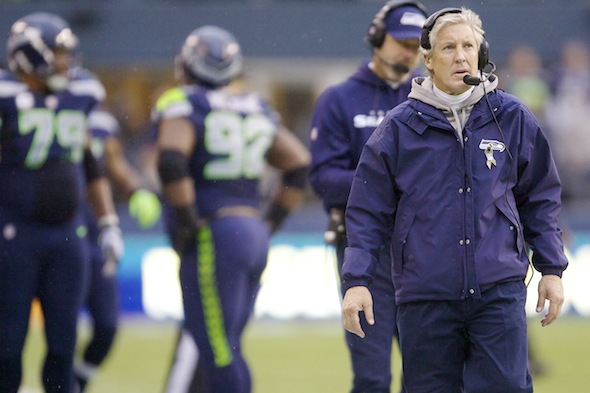
If the expectation is that the Seahawks are in full twitch about who’s been exposing their bodily fluids to public scrutiny, it was not apparent Wednesday afternoon in the locker room.
In fact, cornerback Richard Sherman, one of the alleged miscreants who tested positive for a banned stimulant, held court as usual, chatting away about the Seahawks dealing with the Bears in Chicago Sunday as well as how he’s dealing with being labeled a drug cheat in media reports.
It’s all a misunderstanding, Sherman said. And he doesn’t care about the hub-bub.
“Not at all. Not at all,” he said, smiling at his questioners. “It doesn’t affect me at all. It happens like that in life. There’s always misunderstandings and mishaps. All you can do is go out and continue the job the way you’ve been doing it. Let everything play itself out.”
Sherman sounded very confident of his innocence.
“The truth always comes out,” he said. “You know what you know.”
Of course, similar things were said by Lance Armstrong, Roger Clemens, Barry Bonds, et al. The truth of the episode is not publicly known, and given how it has unfolded despite the purported secrecy of the NFL’s drug policy, it may not be known for awhile but for now he assures he consumes only legal steroids.
More immediately, the Bears game looms large. Sherman and his fellow tainted cornerback, Brandon Browner, will play, pending a yet-to-be-scheduled appeal of the “misunderstandings and mishaps” that will challenge their pending four-game suspensions.
Coach Pete Carroll is certain no distraction will compromise Seattle’s play. Naturally.
“I felt like, at the walk through just now, that everyone was in it, we were rolling,
we were into the next plan and that’s what has to happen,” Carroll said. “I feel like they have responded well. We have talked about any issues that can come up, and those issues are no different than what everybody faces.”
What he was talking about was the potential loss of Sherman and Brown relative to the real losses on Chicago’ injury list, in which six starters, including WR Devin Hester (concussion) and LB Lance Briggs (ankle), didn’t practice Wednesday.
“Chicago has six guys hurt. How do you deal with that?” Carroll said. “You just take them on, face it up and go. So right now, whatever you’re referring to (the drug-test controversy), is not an issue in our locker room. We’re playing football.”
Glad that was established. No one wants to play pee-in-the-bottle very long.
Unfortunately, for the Seahawks and the NFL, the broader issue is more likely to blow up than blow away, at least if you listen to Michael Robinson, the Seahawks starting fullback, union rep, Penn State grad and one of the sharper tools in the Seattle woodshed.
He claims nearly complete ignorance about the use of a particular stimulant, Adderall, that is said to be behind the suspension of at least 11 NFL players over the last year, and is suspected as the banned substance in Sherman and Browner. The NFL does not test for a specific brand of drug, but players and their agents, including Seahawks guard John Moffitt, who sat out four games, have identified Adderall, an amphetamine that treats attention-deficit disorder, as the pharmaceutical edge-du-jour.
“To be honest, I didn’t know what it was until a few week ago,” said Robinson. ” I hadn’t heard of Adderall until this year. It’s more of new-generation type thing.
“When I think of performance-enhancers, I think of something that makes me run faster or jump higher; really getting an edge. I just wish with some of those substances, they’d clear it up so we know what’s going on.”
Responding to questions, Robinson made it clear that he and the Seahawks have had little information from the league or the union on Adderall, even though it has been on the banned list since 2006 and Robinson acknowledged having received the standard list of forbidden pharms before the season.
Asked if he thinks player misunderstanding is widespread, he said, “I think so; one man’s opinion. If the league is really concerned about our health and safety, they’d educate us more. (Once) they educate us, then it falls on the player.”
Robinson said in the preseason, players had a mandatory session about the use of a severe pain-killing drug, Toradol , which was specifically addressed in the new collective bargaining agreement that ended the 2011 lockout. For years, shots often have been administered during games to get players back on the field, a practice some have called abusive. The new rule is that unless a player is under the care of a doctor for the injury in the week prior to the game, a shot can’t be administered on Sunday.
“The only thing I remember (being told) about PEDs is you’re responsible for what goes in your body,” Robinson said. That’s pretty much all they tell us. I’d like to see it cleared up. For instance, I’ve been tested, and I know I’m low on testosterone. Very low. My doctor said, ‘I can’t give you anything, because it’s a banned substance.’ But your body needs testosterone.
“Do I go to the league and ask them what is normal? Or do I continue to get tired, more than I want? It’s a fine line.”
Beyond the issue of education is the issue of confidentiality. The episode blows apart that commitment because the players’ positive test has been outed before the appeal is heard, which is not the protocol.
“It puts the players in a compromised position,” Robinson said. “People learn about this watching TV, and their perception is reality. If the media driving a story that some players did something — it might be true or not, who knows? — I think it effects the appeals process. It should be confidential.”
But Robinson admitted that if the allegations are upheld, and Browner and Sherman are lost for four games, it will create a wound.
“They are Pro Bowl-caliber players and we expect them to handle themselves accordingly,” he said. “Hopefully, we have them. If not, others will step up.
“I think anytime one of your teammates is allegedly in trouble, it is disappointing. Not only for the team but the player, because you know how much they put into the team.”
And by extension, how much the team has put into them. Teammates are counting on Sherman’s view that it is all “misunderstandings and mishaps,” because a suddenly vulnerable defense needs their full participation to make the playoffs. If Sherman is wrong, then a lot of people are going to be looking at anti-depressants.
6 Comments
you must vote for sammy sosa for hof, art.
http://www.youtube.com/watch?v=9mVCg0RGMUs
Wrong topic, not. I have always declined my BBWAA vote. Not my job to give awards in someone else’s industry.
Yeah right, so did Armstrong.
Sherman & Browner – Dumb and Dumber
As I told Matt, not enough is known by outsiders to pass judgment on anything, including player intelligence.
I’m with big #26 on this issue. Sort of. I really don’t know if the NFL just sort of hands out a DO NOT TAKE list and says, “The rest is up to you guys.” And while an individual is always ultimately responsible for what goes into his body, it’s a myth that all athletes at this elite level are health and nutrition experts and know exactly what they’re doing at all times. So, If Michael Robinson says there should be more education involved, then there probably should be. But if the punishment is as dire as a four game suspension, that education should come from each team organization, more so than from the league, just as each team must manage their own injuries.
As far as Sherman’s case goes. Well, mix-ups are always possible. Anyone who’s ever played team sports has either shared theirs or has drunk from a teammates water bottle. It happens all the time. It’s not even a stretch. But the fact that two guys who play the same relative position both tested positive at the same time, both of whom strike me as very smart dudes who do know exactly what goes into their bodies at all times…. You’d think the test numbers would be able either support or reject such a claim. But of course we’ll never see those.
I have no idea what the protocol is upon receiving a positve-for-PEDs test result. But what if the alleged player were informed immediately after a game and must submit a follow-up test sample at that time? If it comes back negative, it’s a pretty good sign of a mix up. If the player refuses, it’s a pretty good sign of guilt.
Good points, Matt. We have so little direct evidence to evaluate claims, and everything is second-hand except for Sherman’s direct comments to media Wed. I would recommend fans take a chill pill regarding passing of judgment, except for the issue of the results getting out (hate to say leaked here) ahead of the appeals. Seahawks have a right to feel screwed on this one.